The History of the Tuesday Music Club/Lakeland Music Club
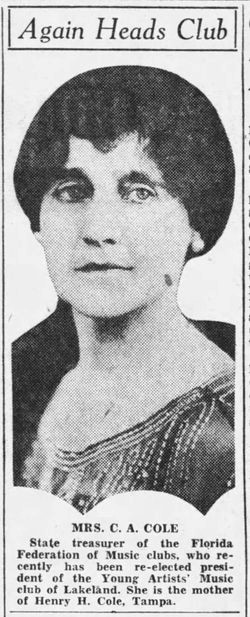
Under the leadership of Mrs. C.A. (Bertha) Cole (1866-1957), plans for the organization of a music group called the Tuesday Music Club began in 1920. The Club was formalized in 1921 with the election of officers (including Bertha Cole as its first president), the adoption of a constitution and by-laws, and thirteen charter members. The first regular program meeting took place on November 11, 1921. The Lakeland Evening Telegram wrote “The Tuesday Music Club held its first open meeting at the home of Mrs. R.N. Skipper on East Palmetto Street. The house was artistically decorated with a profusion of cosmos, chrysanthemums and roses in yellow, the club colors being yellow and black.” In its early years the club typically met in a member’s home and all members were expected to be performing musicians who would periodically contribute to the programs.
Notable activity began early in the club’s history. In January, 1922, the meeting was devoted to the French woman composer Cécile Chaminade (1857-1944). In March of 1922 Bertha Cole hired an agency to provide Lakeland with an Artist Series starting in 1923. The first performance planned was Mozart’s “Cosi fan tutte,” to be presented in English by seven singers and a pianist. The Evening Telegraph noted this would be “the first time a high class opera will make its appearance in Lakeland.” In the 1920s the Club presented Geraldine Farrar to the community. In the 1940s the Club sponsored several notable musical artists, such as pianists Claudio Arrau and György Sándor, and singer Jamilla Novotna.
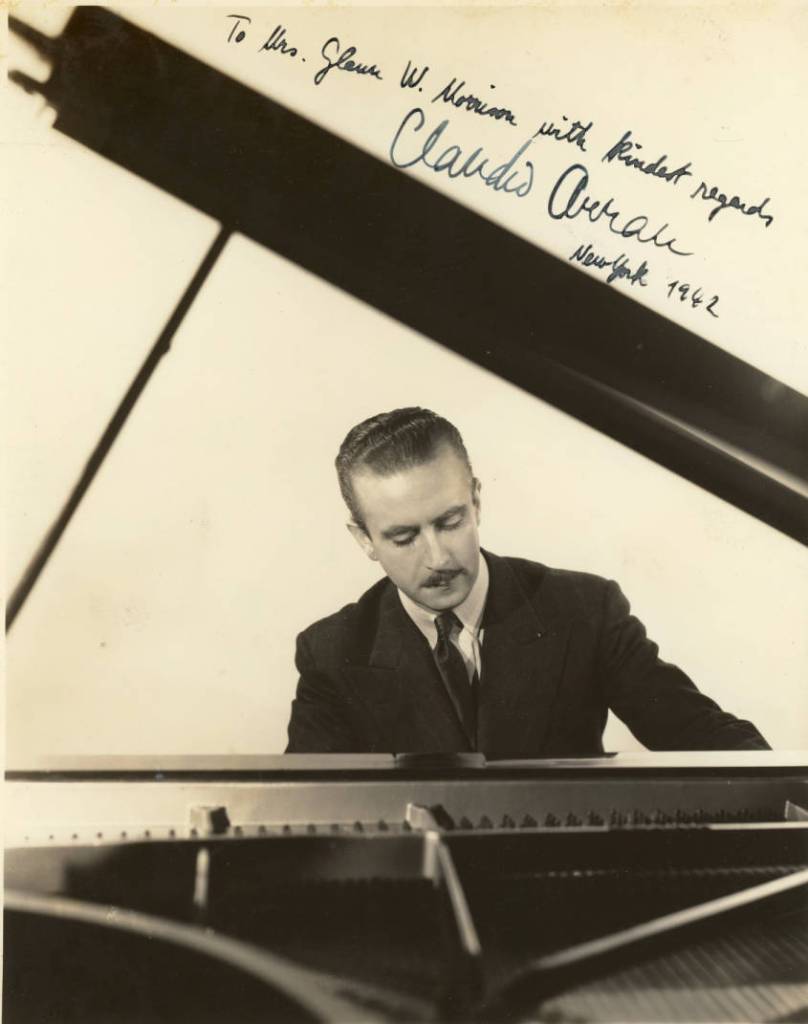
(above) Pianist Claudio Arrau gave a performance in Lakeland at the College Heights Methodist Church at the invitation of the Tuesday Music Club.
In addition to meeting in members homes, the Tuesday Music Club met at Florida Southern College and the Women’s Club before holding its meetings in Mayhall Auditorium from 1949-1954. In the fall of 1954 the Club moved into its own facility, The Tuesday Music Club House on 421 E. Park Street in Lakeland. The Tuesday Music Club building was apparently the first club house owned by a Federated Music Club in the United States. The Club eventually sold its “beloved, weary and aged clubhouse on Park Street” after a span of more than sixty years and in 2016 moved its meetings to the United Women’s Club of Lakeland at 1515 Williamsburg Square. The following year the name of the Club was changed from the Tuesday Music Club to the Lakeland Music Club. From a start of thirteen members, the Club grew to over 140 members in the 1980s. The Club is presently smaller but continues to be enthusiastic and active.
Throughout its history, the Club has fostered and promoted music in all forms and encouraged an appreciation of music in the community. For its programs, the Club originally drew from its own members and presented mostly classical music. As decades passed the Club attracted non-performing music lovers as well as performers and hosted more performances from non-member musical talent in the greater Lakeland area and broadening the genres represented. It has consistently placed an emphasis on acoustic instruments and active personal engagement in music making.
Another important feature of the Club’s identity is its support of young musicians through scholarships and performance opportunities. The Junior Music Club started in 1926-1927 and flourished for several decades. The Club has sponsored young people to participate in state scholarship auditions and to attend summer music camps. By the 1990s the Club had established its own scholarship/award program that it conducts each spring. A first, second, and third place winner in our high school and college divisions is awarded monetary support and invited to perform for the Club.
The Lakeland Music Club held a Centennial Celebration in December of 2021 with a special musical program as well as the presence of Lakeland mayor Bill Muntz. We invite everyone who is interested to join us for our second 100 years.
If you are interested in an “in depth” look at our history, please continue . . .
Tuesday Music Club Early Years
The information below is taken from the Lakeland Evening Telegram newspaper
(The first four entries below reflect that at least one music club preceded the Tuesday Music Club. News about the Tuesday Music Club begins with the 6/1/1921 item).
12/10/1912: Members of “the Music Club of Lakeland” performed for the Florida Baptist Missionary Union at the Auditorium.
8/29/1913: The” Lakeland Friday Music Club” gave a “reception and musicale” in honor of Mr. J. Henry Orme, who was leaving for Los Angeles. Mrs. K.S. Madden was the club’s president and Mrs. S. T. Fletcher its musical director. Mr. Orme sang and other individuals performed, including the Friday Musical Chorus.
5/23/1914: Before adjourning for the summer, the “Lakeland Music Club” elected officers for the next musical season: Mrs. K. S. Madden, President; Mrs. H. J. Drane, Vice President; Mrs. O. M. Eaton, Secretary; Mrs. H. D. Mendenhall, Treasurer; Mrs. S. T. Fletcher, Musical Director; and Miss Portia Patterson, Librarian.
6/5/1914: The last performance reported by the newspaper was an informal tea held at the homes of Mrs. C. W. Hinsdale (the sister of Mrs. Madden) and Mrs. S. M. Stephens on the shore of Lake Hollingsworth. About 75 people attended.
6/1/1921: “ORGANIZATION OF MUSIC CLUB IS COMPLETED. That Lakeland again has a music club will be good news to the many who have felt the lack of such an organization in the past few years.
A group of those interested met some time ago at the home of Mrs. C. A. Cole and the project was gotten under way. The second meeting was held on Monday at the home of Mrs. H. E. Memminger, when the organization was perfected.
The club will be known as the Tuesday Music Club, and the following officers have been chosen: President, Mrs. C. A. Cole; vice president, Miss Elizabeth Pritchett; secretary, Mrs. R. N. Skipper; treasurer, Mrs. C. M. Clayton.
The committee appointed to prepare the year book for next season consists of Mrs. John S. Edwards, Mrs. W. H. Munn and Miss Ellen Hodges.
After completing the organization and discussing plans for the future, the club adjourned for the summer. For next season, the club has in mind a series of musical evenings. The object aside from the pleasure and profit to the members themselves, is the cultivation of public appreciation of the best music.
It is stated that the present membership regards itself as merely the nucleus for a much larger organization. At present the members are Mrs. H. E. Memminger, Mrs. R. N. Skipper, Mrs. C. M. Clayton, Mrs. W. H. Munn, Mrs. G. T. Hickey, Mrs. Joseph H. Neville, Mrs. Paul M. Henderson, Mrs. John S. Edwards, Mrs. W. S. Moore, Mrs. C. A. Cole, Miss Katherine Kauffman, Miss Elizabeth Pritchett, Miss Ellen Hodges.” [The 1932/33 Yearbook also lists Mrs. E. N. Good as a charter member, and she is included as a charter member in the 11/23/1921 Evening Telegram article.]
10/10/1921: The first meeting of the new season was announced, with a program under the theme “Music, O Music, now create a land Of lovely chords where life no longer jars, Nor jolts, nor frets, but glides.” The club planned to meet every two weeks, with an open meeting every six week.
11/9/1921: “The Tuesday Music Club is starting its year’s work with splendid interest. The first half of the season will be devoted to a study of the old masters, while the second half will be given over to a study of famous operas.”
11/23/1921: “The Tuesday Music Club held its first open meeting at the home of Mrs. R. N. Skipper on East Palmetto street. The house was artistically decorated with a profusion of cosmos, chrysanthemums and roses in yellow, the club colors being yellow and black. The following program was given: Piano Duet—Poet and Peasant (Fr. Von Suppe), Mrs. G. T. Hickey and Mrs. R. N. Skipper. Vocal Solo—The Charm of Spring (Robert Coningsby Clarke), Miss Ellen Hodges. Paper on American Music—Mrs. C. A. Cole. Piano—Erotick [Erotik – Poéme érotique] (Greig [Grieg]), and Romance (Rufustin [?]), Mrs. John S. Edwards. Violin—Nocturne (Chopin), Mrs. R. H. Polk. Vocal Solo—Spring Tide (Reinhold Becker), Miss Katherine Kauffman.” Mrs. Polk presented an encore where she sang to self-accompaniment.
“The club was organized last spring [spring of 1921] with the following charter members: Mrs. C. M. Clayton, Mrs. H. E. Memminger, Mrs. R. N. Skipper, Mrs. C. A. Cole, Mrs. G. T. Hickey, Mrs. E. N. Good, Mrs. John S. Edwards, Mrs. B. H. Harnley, Mrs. W. H. Munn, Mrs. W. S. Moore, Miss Katherine Kauffman, Miss Elizabeth Pritchett and Mrs. J. J. Neville. Since then Mrs. T. B. O’Steen, Mrs. C. E. Smith, Mrs. J. E. Johnson, Mrs. Frank Thompson and Mrs. Barnwell Fuller have been added to the list.”
12/7/1921: Current events of the musical world were discussed. Chopin was the composer of the month, including “a skillful interpretation of an etude by Chopin.”
12/21/1921: Twelve members attended the Tuesday Music Club meeting. The music presented included Godard’s Fourth Mazurka. Mrs. C. A. Cole read a paper on the lives of Mendelssohn and Rubenstein.
1/12/1922: The day is devoted to the life and works of Grieg. Fifteen members and five guests attended. Mrs. W. H. Munn prepared the paper read by Mrs. Roscoe Skipper. “I Love Thee” was sung and “The Butterfly” played. After the regular program, “At Dawning” by Cadman was sung.
1/26/1922: The meeting was devoted to a French woman composer, Cécile Chaminade (1857-1944). A paper on her life was presented by Mrs. Clarence E. Smith. Additionally “Mrs. Frank Thompson gave a beautiful rendering of Chaminade’s ‘La Morena,’ and Mrs. C. A. Cole sang a lovely number, ‘I Love Thee,’ by Chaminade.”
2/15/1922: The first open meeting of the new year was celebrated. Club members and guests attended at the home of Mrs. C. A. Cole on Lake Morton Drive. The Evening Telegram reported the following program: Piano Duet—“Poet and Peasant” (Von Suppe); Violin Solo—“Meditation” (no composer listed, perhaps Massenet?); Piano Solo—“Valse Orbesque” (Lack); Vocal Solo—“Where the Linden Blooms” (Dudley Buck); Piano Solo—“Barcarole” (Rubenstein); Vocal Solo—“Roses” (Gove); Piano Solo—“Egeria” (Kroger); Vocal Solo—“Villanelle” (Ocqua); Piano Solo—“La Morena” (Chaminade); Violin Solo—“Berceuse” (Simon); Piano Solo—“Cascade du Chaudron” (Bendel); Vocal Solo—“Doris” (Nevin); and the Bridal Chorus (Wagner?)
3/1/1922: The Tuesday Music Club met on Tuesday afternoon. “The general subject for the afternoon was the life and works of McDowell [Edward MacDowell, 1860-1908], the American composer.” Mrs. Smith read a paper on his life. Performances of MacDowell compositions included “To a Wild Rose,” “Autumn,” “To a Water–Lily,” and “Thy Beaming Eyes.”
3/8/1922: The Tuesday Music Club, through its president, Mrs. C. A. Cole, hired an agency to provide an Artist Series starting in January, 1923. The first performance would be Mozart’s “Cosi fan tutte,” presented in English by seven singers and a pianist. The newspaper described this as “the first time a high class opera will make its appearance in Lakeland.” Two other performances, one featuring a “famous interpreter of Indian songs and legends” and the other a “noted Roumanion [sic] contralto,” were also advertised.
3/15/1922: Mrs. W. H. Munn hosted the Tuesday Music Club on her veranda at her home on Lake Hunter. “A short, interesting program was given on the general topic, ‘The Opera.’” Ice cream and cake was served.
4/13/1922: The club conducted its regular Tuesday afternoon meeting and held an election of officers. The club voted to federate with the Florida Federation of Music Clubs. A program on “German Opera” was presented, as well as the performance of two solos and a feature called “Current Events.”
4/26/1922: The subject of the meeting was “French Opera.” The program included: a paper on “Faust,” a paper on “Les Huguenots,” the solos “Sing, Smile, Slumber” and “Flower Song” by Gounod, a piano duet by Gounod titled “Faust Waltz,” violin selections, and two piano solos by Meyerbeer—“Coronation Waltz” and “Lowly Maiden.”
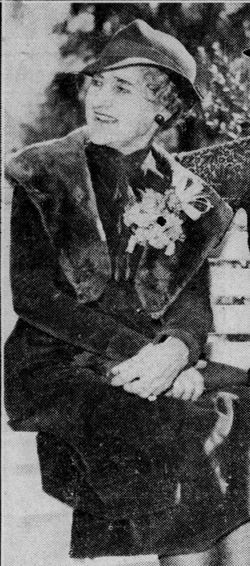
(above) Bertha Cole (1866-1957)
Yearbooks from the Tuesday Music Club/Lakeland Music Club
The Lakeland Public Library holds an archived collection of Yearbooks published by the Tuesday Music Club, an organization that changed its name to the Lakeland Music Club in 2017. These Yearbooks contain extensive information regarding the Club. They are digitalized and can be found online.
The information below notes each Yearbook in the collection (a number of years are missing) and provides a few details regarding the materials in each edition. The holdings begin with the 1923-1924 Yearbook.
Yearbook, 1923-1924: The October meeting focused on Louis Gottschalk, the February meeting on Reginald DeKoven, and the March meeting on “Well Known Women Composers” Cécile Chaminade, Carrie Jacobs Bond, and Mrs. H. H. A. Beach.
Yearbook, 1924-1925: Fall focus: the piano, the voice, harmony, and musical forms. The February meeting addressed “American Music (Indian and Negro).” Music performed that month includes “Indian Suite No. 3” by MacDowell and “The Banjo” by Gottschalk, as well as selected spirituals. The rest of the year featured meetings on the Oratorio and the Opera and an organ recital.
Yearbook, 1925-1926: The year focused on the fundamentals of music, including rhythm, melody, harmony, polyphony, form, acoustics, and expression/interpretation. There was also a sacred program, a program of Spanish music, and a “Shakespearean program.”
Yearbook, 1926-1927: By the sixth year there are 46 active members. The Yearbook reflects a more general programming. There are two “Miscellaneous” programs, two “Guest Afternoon” programs, and a “New Member” program. The most specific program was titled “Lullabies of All Nations.” Perhaps the most notable meeting was a “Junior Program.” Unlike previous years, no specific repertoire is noted, just the program name and the performers.
Yearbook, 1927-1928: The general nature of programming continues this year. The January 24th program is a “Junior Music Club” program. The last meeting of the season was a “Request Program.”
There are no Tuesday Music Club yearbooks at the Lakeland Public Library for 1928-1929 or 1929-1930. Mrs. C. A. (Bertha) Cole stopped serving as President in 1928 and organized a club known as the Lakeland Artists’ Music Club. It changed its name to the Bertha Cole Artists’ Music Club in 1935 and to the Bertha Cole Music Club in 1953. The first yearbook from this group in the Lakeland Public Library dates from 1936-37. The topics and style of meetings noted in this yearbook more closely resemble the early years of the Tuesday Music Club: more specific programs with the pieces as well as the performers listed.
Yearbook, 1930-1931: More specific programming returns to the Tuesday Music Club Yearbook, at least with titles of pieces listed as well as performers. The November 25 program featured women composers, including Julie Rive-King (1854-1937), Jessie L. Gaynor (1863-1921), Lily Strickland (1884-1958), Carrie Jacobs-Bond (1862-1946), Mana-Zucca (1885-1981), Pearl G. Curran (1875-1941), Mrs. H. H. A. [Amy] Beach (1867-1944), and Mary T. Salter (1856-1938). The Junior Music Club was featured in January. Various composers were focused on in the spring.
Yearbook, 1932-1933: Club Historian Summerville B. Edwards (Mrs. J. S.) wrote an article titled “Looking Backward” in the beginning of the Yearbook. Salient information from this writing includes:
- 1/7/1921—plans from 1920 were formalized when “an interested few” met at the home of Mrs. C. A. Cole. “Those few comprised the charter membership of a new organization born that day and christened “TUESDAY MUSIC CLUB.” Officers were elected, with Mrs. Cole as President.
- A second meeting on May 30 saw the adoption of a constitution and by-laws.
- 11/11/1921: The first regular program meeting with the first yearbooks. Five members were present.
- Mrs. Cole served as president until 1929, with the exception of a half a season when E. N. Good served. During this time the club joined the State and National Federations of Music [Summerville writes that this happened in 1921, but the Lakeland Evening Telegram reported that it was voted for on 4/13/1922]. The club presented several musical artists, including Geraldine Farrar.
- 1926—the first annual observance of National Music Week.
- 1926/1927—the organization of the Junior Music Club.
- 1929—Bertha Cole resigned as president, earning the title “Mother of the Tuesday Music Club” and receiving the first Honorary Life Membership.
- 1929-1930–Two terms were set as the limit of consecutive service for a president. The Tuesday Music Club Chorale was organized. A memorial to Edward Bok was held.
- 1930-1932—the Juvenile Music Club was started (in addition to the Junior Club) and State Composer Program was a new feature of the yearbook.
(Continuing) Yearbook, 1932-1933: On Reciprocity Day (11/22/32) the Brooksville Music Club performed. On 12/13/32 the Club sponsored a performance of Handel’s “Messiah.” February 14, 1933 was the Florida Composers Program, though no specific composers were listed. On March 28 (“In Honor of the Tourists”) the Club presented “ The Morning of the Year,” a song cycle by Charles Wakefield Cadman. April 11 was dedicated to Modern Composers, including Albéniz, Hageman, La Forge, De Bussy [sic], and Hahn. The Junior Music Club met once a month October –May.
Yearbook, 1934-1935: The Club met in the Drawing Room at Florida Southern College on the second and fourth Tuesdays of the month at 10 a.m.
Yearbook, 1935-1936: The Yearbook lists its meeting place as “Woman’s Club.” Other “Announcements” continue as previous years, including: “All papers read to the Club are limited to fifteen minutes.” “A member shall be fined One Dollar for failure to perform her part on the program, unless a substitute be furnished or excused by the Board.” “A member absent for three consecutive meetings for any reason other than sickness or protracted absence from the city shall forfeit her membership unless excused by the Board.”
Yearbook, 1936-1937: As in several years past, the club colors are orange and black, the club flower is the Black Eyed Susan, and the club song is “America the Beautiful.” Programs included “Beethoven, The Man Who Freed Music” and dramatic soprano Dorothea Benson in a voice recital.
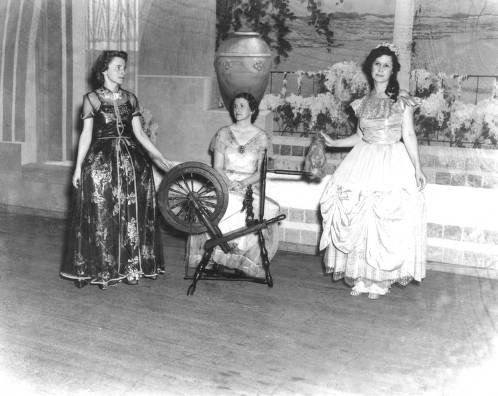
(above) Members of the Tuesday Music Club in Lakeland, Florida in costume for a 1938 performance. They are, left to right, Ruby Ralston, Thelma Rawls, and Hazelle Morrison.
Yearbook, 1938-1939: Numerous committees served the Club, including a six member Radio Program Committee. Programs included a Stephen Foster memorial and a program titled “Builders of Music In America” that included Ferde Grofé’s “Grand Canyon Suite” and a song by Burleigh.
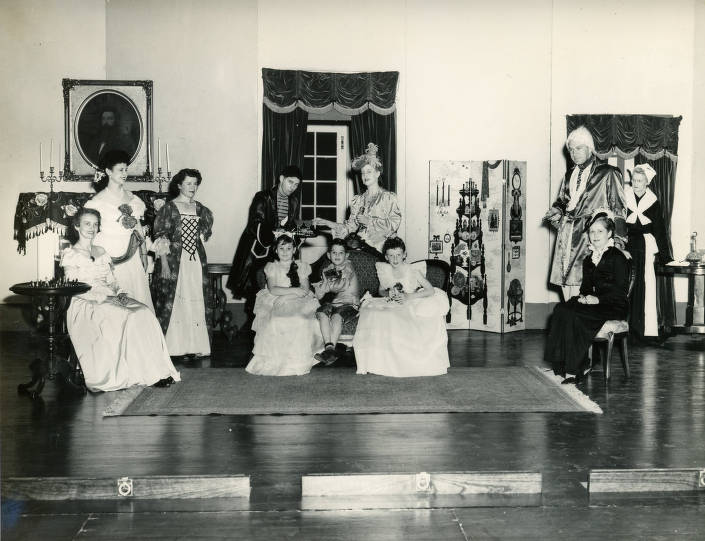
(above) Actors perform a one-act play written by Hazelle Morrison titled “An Hour From a Lovely Yesterday” at the Mayhill Auditorium. The play was sponsored by the Tuesday Music Club sometime in the early 1940s.
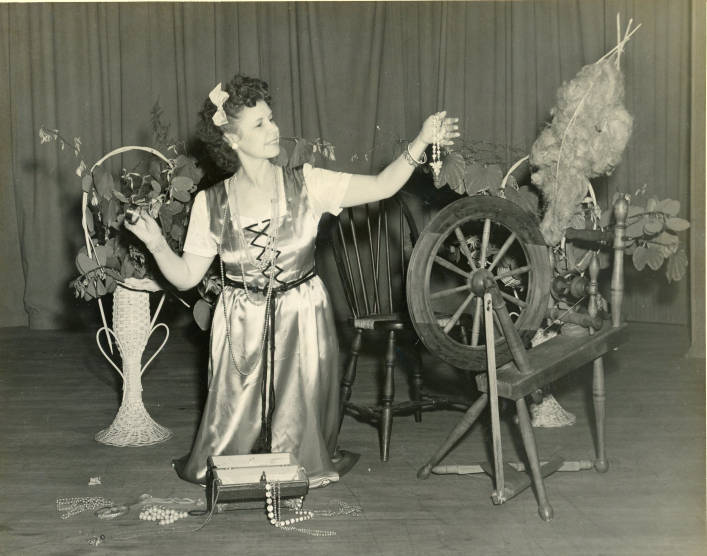
(above) Hazelle Morrison performing “The Jewel Song” for the Tuesday Music Club in 1944.
Yearbook, 1940-1941: The Club meets at the Woman’s Club. March, 1941 featured a program that traced the history of music as a precursor to swing. This included the evolution of syncopation, the influence of Scott Joplin, and the ongoing development of jazz after World War I.
Yearbook, 1941-1942: The October program was titled “Music of the Sea” and featured “Barcarolle in A Minor” by Rubinstein. November had an international theme, including “Molly On the Shore” by Grainger, “Prayer of the Norwegian Child” by Kountz, “Swiss Echo Song” by Eckert, as well as compositions by Rimsky-Korsakoff, Paderewski, Respighi, Gretchaninoff, Debussy, Rachmaninoff, and Malotte. February was devoted to ensemble music, utilizing the talents of a piano ensemble, a vocal trio, a violin choir, and the Lakeland Male Chorus.
Yearbook, 1942-1943: This year there was a War Service committee. There were three “Departments:” Junior Music Club, Tuesday Music Club Chorus, and Little Symphony Orchestra. Programs included “American Women in the Field of Music” and “The Tuesday Music Club honors the Bertha Cole Artist Club.” In the “Program of Ensemble Music” they appear to have a group playing four pianos, called The Southern [College] Eight, directed by Dr. George L. Tenney.
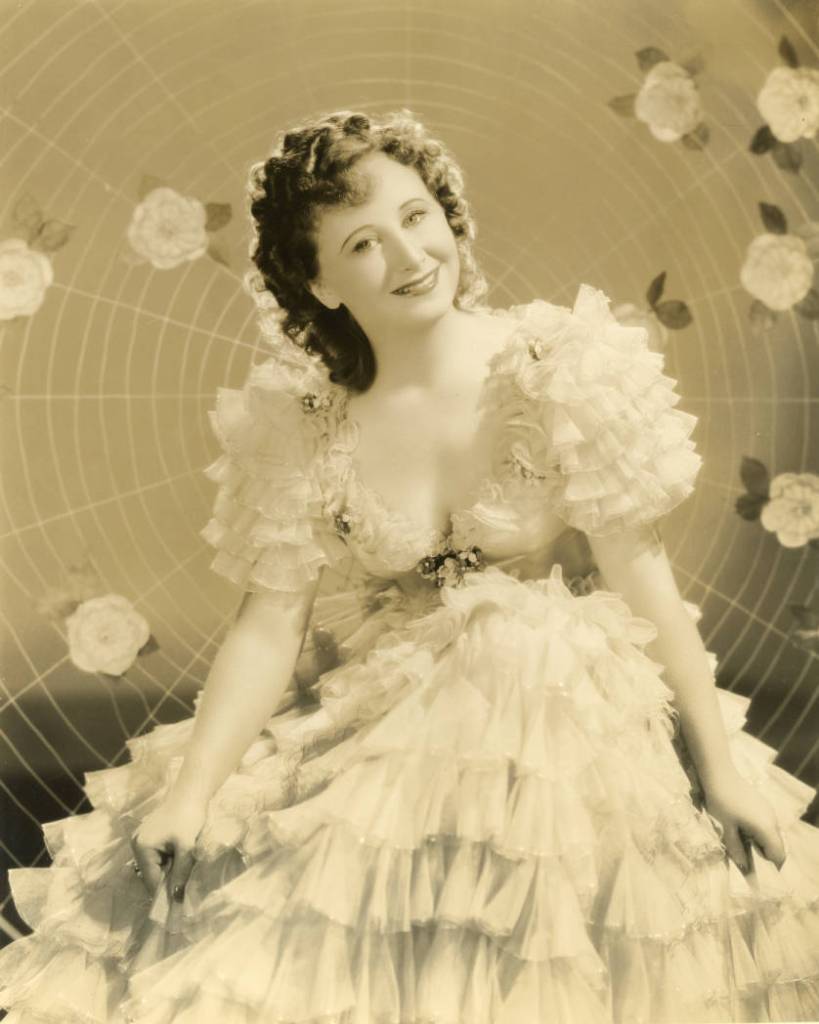
(above) At the invitation of the Tuesday Music Club, soprano Anne Jamison came to Lakeland some time in the 1940’s to perform at the Lakeland Civic Music Center.
Yearbook, 1943-1944: The November program presented the music of Olive Dungan and the poetry of Nina Z. Chilson. Dungan studied at the Pittsburgh Institute of Musical Art and the Miami Conservatory. She lived in Miami and was active in the Miami Music Club. Her most famous composition is “Eternal Life.” The Club continues its annual Christmas Sacred Concert in December. In January a solo quartet performed “In a Persian Garden” by Liza Lehman. April was devoted to “MacDowell, the Musical Poet of nature.”
Yearbook, 1944-1945: October was devoted to works by Victor Herbert, with the Tuesday Music Club Chorus closing the program with “Italian Street Song.” January’s first program was titled “The Strauss Family,” featuring compositions by Johann Strauss (Vater), Johann Strauss II, Joseph Strauss, Richard Strauss, and Oscar Strauss. The second program in January focused on music by Charles T. Griffes. March saw a program of music by George Gershwin, including several works from “Porgy and Bess.”
Yearbook, 1945-1946: The Club Song is not listed this year. Programming included an evening with Brahms and a lecture-recital on “The French Art Song” by Mr. Colin O’More. O’More joined the music department at Florida Southern in 1943. He recorded the Jerome Kern song “Till the Clouds Roll By” as a duet that was a number one hit on the charts in 1917. He was also a pioneering radio and television executive with CBS and NBC before coming to Lakeland to teach.
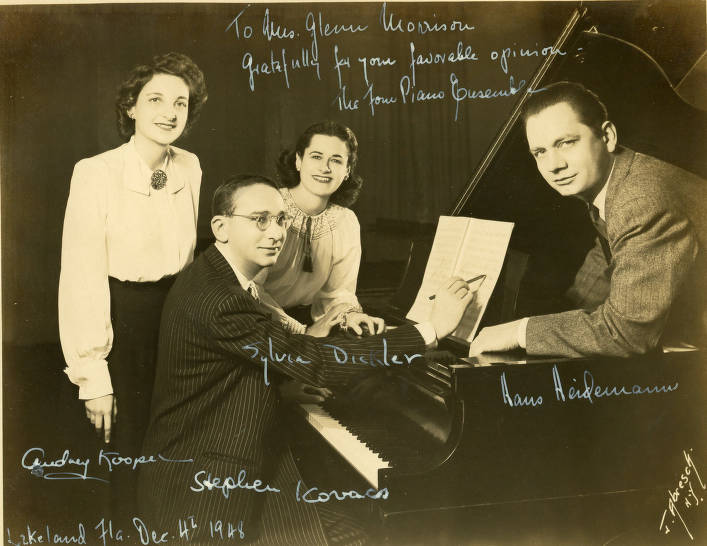
(above) In 1948, professional musicians Stephen Kovacs, Audrey Kooper, Sylvia Dickler, and Hans Heidemann of the Four Piano Ensemble came to Lakeland at the invitation of the Tuesday Music Club.
Yearbook, 1946-1947: This year the Club met at the Lakeland Yacht Club. In January they presented pianist Emilia D’Aliberti in concert at Mayhall Auditorium. In May they hosted a musical tea honoring their music teachers.
Yearbook 1947-1948: The Club moved to Mayhall Auditorium this year (see 1949-1950 for more information). Early music was a focus for the year, including programs on “Music In Its Infancy,” “Music of the Middle Ages,” “Music of the Renaissance,” and “Musical Morning With Mozart.” The Club presented Leo Podolsky in a piano recital in November. Podolsky was born in Russia in 1891 and concertized throughout Europe before debuting in Chicago in 1935. He taught at the Sherwood Music School in Chicago for 58 years, and died in 1987.
Yearbook 1948-1949: Australian Vina Barnden is this year’s featured concert pianist. A program of music by Bach is conducted at All Saints Episcopal Church in October. Other classical composers featured during the year include Beethoven, Mendelssohn, Schubert, and Schumann. In March the Club presented Menotti’s “The Telephone” (first performed in New York City just two years earlier in 1947). The Club’s own Elizabeth Alderman Barnum sang the soprano role of Lucy while Billy Jones from Stetson University sang the baritone role of Ben.
Yearbook, 1949-1950: The Club met in the Mayhall Auditorium. Mayhall Auditorium was built in 1927 and named in the 1940’s after longtime Lakeland High School music director and composer, Harry S. Mayhall. The Auditorium was razed in 1969. Programming included a study of Grieg and a study of Gilbert and Sullivan.
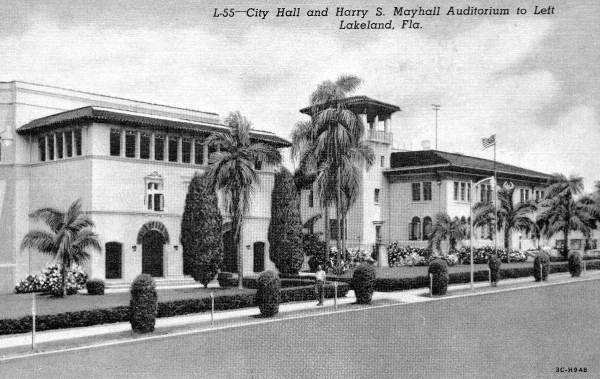
Yearbook, 1950-1951: Programs included “Bach: 1750-1950” (the 200th anniversary of Bach’s death) and “Recital: Laura Neil Leonard Clyatt” (Clyatt was a pianist who lived from 1913-2002, with the concert held at the Florida Southern chapel). There was also a “Pops Concert.”
Yearbook, 1951-1952: Programs included “Music of the United Nations” and “Past-Presidents’ Frolic.” On another program Dr. Alton Chester Morris from the University of Florida gave a lecture-recital on Florida folk songs and ballads.
Yearbook, 1952-1953: A Building Fund was listed in the announcements—the Club continued to meet at Mayhall Auditorium. No fines are listed . . . Programs included “Music of Edward MacDowell, A Program Honoring Mrs. Marian MacDowell On Her Ninety-Fifth Birthday.”
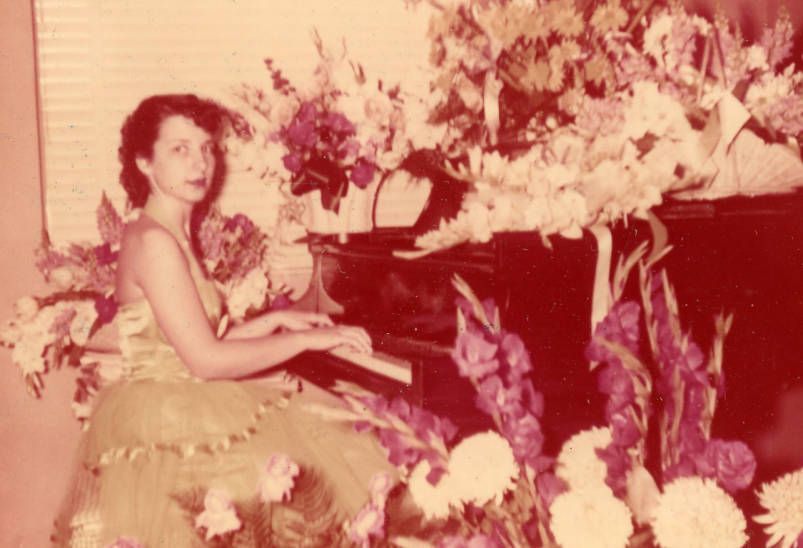
(above) Hazelle Morrison at the piano. 1954-1955 Tuesday Music Club season.
Yearbook, 1954-1955: In this year the Club had its own meeting facility: The Tuesday Music Club House on 421 E. Park Street in Lakeland. The first meeting celebrated the opening of this new facility. Programs included a performance by the Florida Southern College Chorus in January.
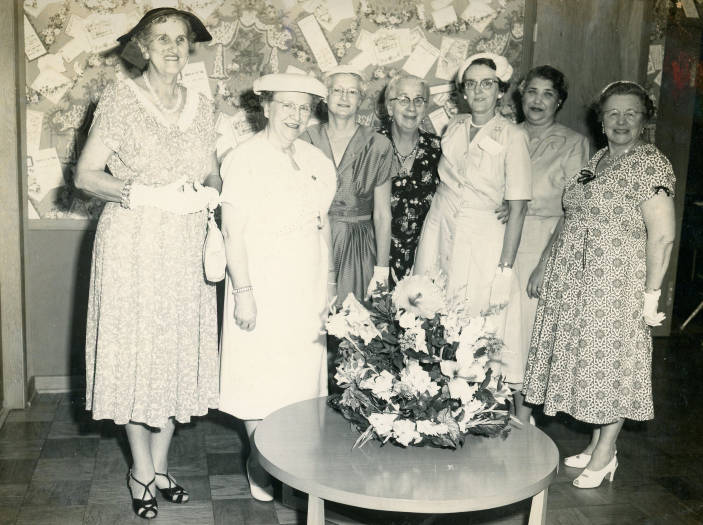
(above) Officers 1955-1956: Officers of the Tuesday Music Club pose for a photograph. They are Mrs. Glenn Marshall, Vice President, Mrs. W. E. Bobo, Vice President, Mrs. Gordon Jusus, President, Mrs. James Taylor, Parliamentarian, Mrs. F. S. Gachet, Recording Secretary, Mrs. R. P. Ammerman, Corresponding Secretary, and Mrs. Angie Keene, Treasurer.
Yearbook, 1955-1956: The Yearbook is dedicated to the President of the Florida Federation of Music Clubs, Tuesday Music Club’s own Mrs. Glenn W. (Hazelle) Morrison. January’s focus is on Rimsky-Korsakov. The Club continues to typically devote a month to Florida composers, and this year’s offering includes music by Ruth E. Day, Hans Barth, Olive Dungan, and William Spivey from Florida Southern College.
Yearbook, 1956-1957: In January the Club presents scenes from George Bernard Shaw’s “Pygmailon” and music from Lerner and Loewe’s “My Fair Lady” (which had just premiered on Broadway in March of 1956). In February music from Victor Herbert’s “Natoma” was performed. The Club’s annual sacred music concert also took place in February.
Yearbook, 1957-1958: The Yearbook is dedicated to Mrs. Roscoe N. (Sue Ella) Skipper, a member since the Club’s inception. One of a number of Reciprocity Programs over the years is conducted between the Club and the Orlando Wednesday Music Club in January. Students and faculty of Florida Southern College presented a program of “International Music” in February. Billy Alton, “an outstanding young pianist from the Florida State University and . . . winner of several awards in the field of music” presented a recital in April.
Yearbook, 1958-1959: Departments included Junior Music Club, Junior High Music Club, Children’s Music Club, and Study Course. The year’s emphasis was on “Around the World with Music,” including a program entitled “Music of the Orient.”
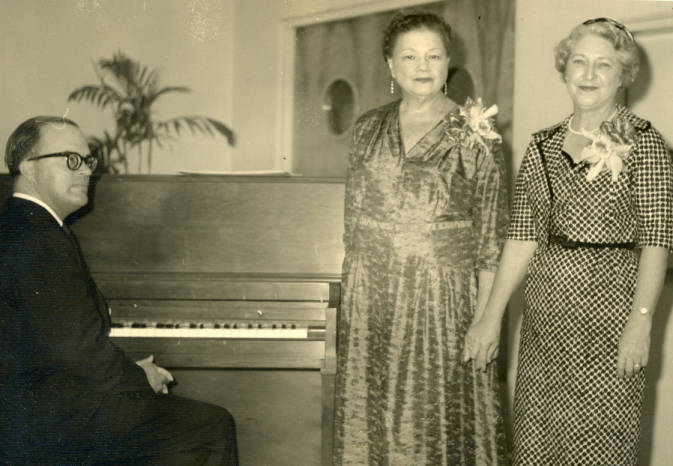
(above) In 1961, President of the Tuesday Music Club Mrs. Joseph Wendell poses for a photograph with Professor William Spivey at the piano and Madame Anne Roselle. Roselle and Spivey were from the faculty of Florida Southern College and were giving a recital called “Middle Europe Speaks in Music.”
Yearbook, 1961-1962: The Yearbook cover design reflects the first dramatic change since the first yearbook. There are no longer descriptions of fines in the Notes. The year’s theme was “Music, the Universal Language.” There is some paid advertising in the Yearbook, but this appears to be the only year that happened.
Yearbook, 1962-1963: The theme was “American Music.” This included the performance of “An American Opera, ‘The Unmusical Impresario’” composed in 1955 by Katherine K. Davis (1906-1988).” Another program was based on “American Tribal Melodies.”
Yearbook, 1963-1964: The Jeannie Ball and Auditions took place in February, 1964. The auditions were for a scholarship program celebrating Stephen Foster, with the name ” Jeannie” derived from Foster’s popular song “I Dream of Jeannie.” During National Music Week in May the Club combined a presentation of the Bertha Cole and Tuesday Music Clubs.
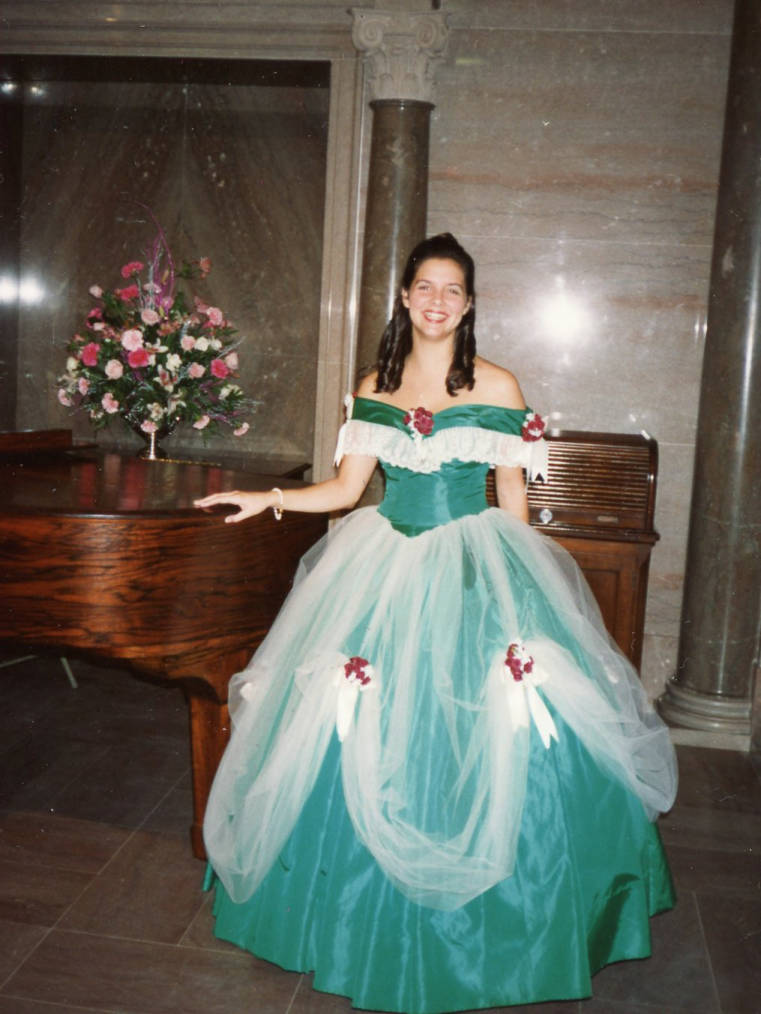
(above) Singer Stephanie Moorhead wears a ballgown as she auditions for the Jeanie Scholarship offered by the Tuesday Music Club in 1987.
Yearbook, 1964-1965: The Club studied a number of musical styles. There was a piano and voice recital and a concert by the Florida Southern College Concert Choir. The final meeting featured a Young Artist Concert followed by a Luncheon and bridge.
Yearbook, 1965-1966: The Club studied different musical eras, including Baroque, Classical, and Romantic. The Study Book for the year was “History of Western Music” by Donald J. Grant.
Yearbook, 1966-1967: The November program was a “Program of Organ and Oratorio” featuring the Chancel Choirs of First Presbyterian and Grace Lutheran Churches.
Yearbook, 1967-1968: There were 24 committees in the Club. The Fall Luncheon featured an address by Lois Hamblett Golding from the University of South Florida and a concert by pianist Janice Bethea from Florida Southern. The next meeting was “Immortal Melodies of Stephen Foster” presented “in costume.” The January 9th program featured music by Frederick Delius. The program of February 12 included “Histoire du Soldat” by Stravinsky performed by the Ensemble from the Lakeland Symphony Orchestra.
Yearbook, !968-1969: The November program focused on Benjamin Britten and William Blake. “The Gift of the Magi,” a “Petite Opera” by Ruth Taylor Magney, graced the stage in December. In January guest soprano Becky Renfroe sang selections from the newly published “The Cat in the Hat” with text by Dr. Seuss and music by Eugene Poddany.
Yearbook, 1969-1970: October featured Bach’s “Concerto id D Minor” and “The Coffee Cantata.” The bicentennial of Beethoven’s birth was celebrated in November and Poulenc and Ravel in March.
Yearbook, 1970-1971: Another Yearbook is dedicated to Mrs. Glenn (Hazelle) Morrison. “Our Golden Anniversary” was celebrated in early October with a skit written and directed by Hazelle Morrison about the founders in 1920. Later in October they performed “Music of Today,” including Bacharach’s “Raindrops Keep Falling On My Head.” Sometimes the Club featured a guest speaker: in January “The Tuesday Music Club honors Mrs. Spesssard L. Holland who will speak with us on ‘My Life As A Senator’s Wife.’” In June the Club presented Frederick Steffen in his Senior Recital. Steffen was graduating from Eastman and studied with the “Head of the Piano Faculty,” Cecile Genhart.
Yearbook: 1971-1972: The proposed budget for the year was $3,275.00. The title of the Ocober program was “Folk Tunes and the Poetry of Carl Sandburg.” January featrued a tribute to Stravinsky, including “Excerpts from Petrouchka” for piano duet (by the composer) and “Sonate pour piano (1924).” February focused on women, with “The Natural Superiority of Men” by Frackenpohl and “The Many Faces of Women, as found in the plays of Tennesee Williams,” presented by Barbara Smith and Julie Rogers, actresses.
Yearbook, 1972-1973: January 9: “Brahms, the Romantic Classicist.” January 23: “Twentieth Century Masters” featured Operatic Soprano Anne Roselle, who sang three songs by Richard Strauss and offered her “Personal Recollections of Strauss.” Roselle was born in 1894, came to the US from Eastern Europe in 1912, had a noted international career that included the first German performance of “Turandot” and the first American performance of “Wozzeck,” was an artist-in-residence at Florida Southern for many years, retired in 1967, and died in 1989 at the age of 95. April 10 focused on settings of poetry by Walt Whitman.
Yearbook, 1973-1974: October 23: “Americans by Choice – United Nations Day” included “Hymn to the United Nations” by Freda Levy. February 12: the program included “Saudades da Brazil” by Milhaud. May 14th featured Timm Anderson, cellist from the University of South Florida.
Yearbook, 1974-1975: A variety of programs were presented. Thanksgiving and Christmas were both celebrated. November 12: “Opera Excerpts.” January 14th: “Program Presented By the Wednesday Music Club of Orlando and Winter Park.” February’s program on American Music included Barber’s “Sure on This Shining Night” and Gershwin’s “Three Preludes,” as well as “Nancy Hanks” by Katherine Davis.
Yearbook, 1975-1976: For the first time, the Club’s colors and flower are not listed on the first page—they are listed later under “Notes.” There were 133 members. The Tuesday Music Club Chorus continued to perform. The theme for the year represented different eras in American history, including “Music of the Revolutionary Years,” “The Blue and the Gray,” and “Development of the West. “ April 27: “Modern Music Development” featured “Minstrel, Rag Time, Blues, Jazz, Swing, and Rock” performed by the Lakeland Senior High School Jazz Band.
Yearbook, 1976-1977: November 9: “Handbell Ringers of Florida Southern College.” December 14: “Spotlight on Organ.” There was a student recital in April, featuring students who studied with 12 different members of the Club.
Yearbook, 1977-1978: Different musical periods were explored. On March 28 the opera “Susanna” by Carlisle Floyd was performed (presumably only excerpts), with the Tuesday Music Club singing with piano accompaniment. Students of the Betsye Kay School of Dance performed on April 25.
Yearbook, 1978-1979: Music from Different Countries was explored. The first movement of de Falla’s piano concerto “Nights in the Garden of Spain” was played in January. The Lakeland High School Orchestra performed in May.
Yearbook, 1979-1980: November 13: “Fountainheads of Music—Bach, Beethoven, Brahms.” January 8: “The Mystic in Poetry and Music,” including piano works by Scriabin and songs settings of William Blake poems by Benjamin Britten, Celius Dougherty, and Virgil Thomson. February 12: “American Patchwork Quilt” including Scott Joplin piano duets, a jazz set with composers Duke Ellington, Dave Brubeck, Erroll Gardner, and Horace Silver, and the first movement of Howard Hanson’s Piano Concerto, Op. 36. March 11 saw a duo-pianist performance of “The Civilian Barber” by Schickele (P. D. Q. Bach).
Yearbook, 1980-1981: November 11: The topic of study was “My Friend, Helen Keller, Her Life and Music.” March 10: “A Tapestry of Music and Prose, woven into a Skit by Hazelle Morrison.” By now the women performers are listed by their first and last names, while the active membership still lists most of them as Mrs. followed by their husband’s name, then followed by their first name in parenthesis—for example Hooks, Mrs. Lloyd C. (Annette).
Yearbook, 1981-1982: November 10 featured a study of the music of Schumann. The “American Salute” on February 9 wove classical and popular composers, including Sousa, Richard Rodgers, Gershwin, Brodszky’s “Be My Love” and Hovhaness’s “Suite for Piano—Opus 96.” May 11 was devoted to “The Impressionists.”
Yearbook, 1983-1984: There were 144 members. A pattern similar to the past decade or so continues: there was a meeting devoted to “European Composers,” there was a Christmas concert, the “Beethoven Era” was the theme of January 10, February contained a “Parade of American Music,” the March study focused on “Contemporary Composers,” April 11 was devoted to a recital by students who studied with members of the Club, and May 9 was titled “Collage.”
Yearbook, 1984-1985: The Lakeland String and Voice Ensemble performed at the October 9 meeting. The Lakeland Senior High School Instrumental Ensemble appeared on the March 12 program. On April 9 a program was presented by duo pianists and a flautist.
The following poem, written by Club member Anne Campbell, was included in the 1984-1985 Yearbook:
“To a Music Teacher
You cannot practice for her every day.
The knowledge that you give to her will not stream
On her young mind in one bright blinding ray,
But you can plant a dream.
Ah, you can plant a dream in her young heart,
A dream of excellence whose light will gleam
Upon her pathway as the years depart.
Your words can plant a dream.
To sow a dream and see it spread and grow,
To light a lamp and watch the brightness gleam:
Here is a gift that is divine I know—
To give a child a dream.”
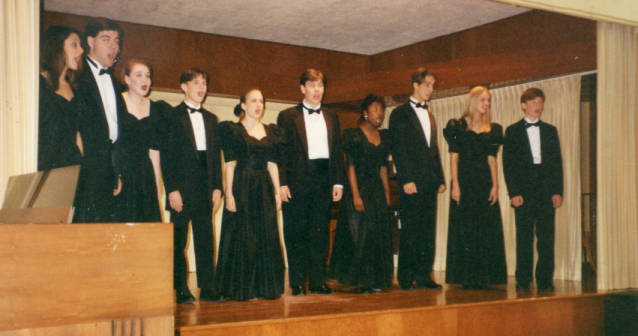
(above) The Harrison Singers give a performance for the Tuesday Music Club in 1993. The ensemble is made up of students who attend the Lois Cowles Harrison Center for the Visual and Performing Arts.
Yearbook, 1990-1991: The Club would typically support various initiatives. The President’s Report by Betty Offermann noted that in 1989-1990 the Club made contributions to the PBS station WEDU, the Bach Festival, and the Performing School of Arts in Lakeland. The Club awarded $200 scholarships to three college students to attend summer music camp. The President also noted “The new Harrison Performing Arts School in Lakeland will be an available resource for ‘talented youth—a look to the future.’” She also noted “The TMC [Tuesday Music Club] Board of Directors accepted the invitation of the Lakeland City Library to have TMC archives of historical value placed in their climate-controlled, fire-proof section, and made available to our club and others interested in our history.” November 13: “A pipe organ recital of Praise and Thanksgiving” at St. David’s Episcopal Church. December 11: “Boar’s Head Ceremony and Feast.” March 12: “The Tuesday Music Club Chorus presented ‘The Reluctant Dragon,’ A Musical Allegory by John Rutter.” The Harrison Fine Arts School Orchestra performed on April 9. The Tuesday Music Club’s balance on April 30, 1990 was $4,750.25. The Club received a National Award of Merit for this Yearbook.
Yearbook, 1991-1992: The “In Memoram” page noted the passing of Hazelle Morrison. In October Jose Bove, a “Guest Musicologist,” conducted a study on “The Magic of Mozart.” “The Grasshopper, A Tragic Tale” by American composers Innes Randolph and Joseph W. Clokey, was performed in February by the Music Club Chorus. In March the Club had “a very successful card party and style show.” The Harrison School of Fine Arts String Orchestra played in April.
Yearbook, 1992-1993: A number of “studies” were conductoed during the year, including a study of Opera Highlights in October, a study of The Story of Christmas in Great Art in December, and the study of Keyboard Classics in January. March produced a “Calvacade of Youth” featuring piano students of various members. Stephanie Moorhead (see picture above after 1963-1964 Yearbook) sang for the Club in May.

(above) The Tuesday Music Club Chorus performs “Brush Up Your Shakespeare” on October 9, 1993.
Yearbook, 1995-1996: This year the Club celebrated its 75th anniversary—the “TMC Diamond Jubilee.” Ellen [Hodges] Meharg survived as the only living Charter Member. She was quoted as saying “The purpose of the club provided that no one would be admitted to membership who could not make a creditable public performance.” Ellen Hodges Meharg passed away in 2005.
Peggy Burr and Nancy Ford wrote a page on the history of the Club, including the following:
- Spring, 1947—When Mary Smith became president, she started a building fund with a $100.00 life membership contribution (now $150.00). Other members have made similar contributions. Within seven years enough capital had been raised to begin construction—the balance was secured by a loan from a local Savings and Loan Association. Wynn Howell was the architect and Morris Pritchard the builder. The building was erected in 1954 and a satisfaction of mortgage was filed in 1970. The Tuesday Music Club building was the first club house owned by a Federated Music Club in the United States.
- 1995—The Tuesday Music Club reaches out to the community with programs and scholarships. Each year a $1000 Marjorie M. Jennings Scholarship in Piano and a $500 Hazelle P. Morrison Scholarship in Music are awarded. Also, the TMC Scholarship Fund gives assistance to qualified students to attend summer music camps and competitions. This fund is made possible by the support of friends and members of the club.
The President’s Report of 1994-1995 included the following:
“Following National Federation of Music Clubs goals, we annually:
- Have three STUDY Programs
- Observe THE PARADE OF AMERICAN Music
- Promote the use of FEDERATION INSIGNIA
- Present a CHAMBER MUSIC PORGRAM
- Hold advertised open meetings
- Include N.F.M.C HYMN OF THE MONTH at each meeting
- Have an ORIENTATION SESSION
- Participate in NATIONAL MUSIC WEEK
- Hold a complete STUDY PROGRAM on GRAND OPERA
- Have an active CLUB CHORUS present a program
- Sponsor a PAST PRESIDENTS’ ASSEMBLY and contribute to YOUNG ARTISTS FUND
- Keep an accurate ACHIEVEMENT BOOK
- Contribute to N.F.M.C. and F.F.M.C projects
- Send representation to DISTRICT, STATE BOARD, STATE CONVENTION and JEANIE AUDITIONS
- Offer a $1000.00 SCHOLARSHIP to a winner in SENIOR PIANO AUDITIONS
- Offer SUMMER MUSIC CAMP SCHOLARSHIPS to young musicians
As much as possible, we try to use the talents of our members in order to foster interest and create good attendance of all members. Inasmuch as we own our Clubhouse, all of our sessions are catered luncheon meetings.”
This yearbook listed two men as members. There were no men listed as members in the 1990-1991 Yearbook or in several other yearbooks where this was checked.
Yearbook, 1997-1998: This edition included “Historical Highlights of the Florida Federation of Music Clubs.” Kathy Harrison was the president this year, and continued to be a member of the Club during the 100th anniversary in 2021. The Club purchased two Yamaha grand pianos and awarded six music scholarships. Faculty from Florida Southern performed at the opening meeting. December 9: The Harrison Singers from the Harrison School for the Performing Arts sang a Christmas program under the direction of Judy McLaurin, another continuing member at the 100th anniversary. The Imperial Recorder Consort, under the direction of Jane Spencer, performed at the January 13th meeting. The same ensemble with the same director performed at the January 10, 2023 meeting—25 years later. Brahms was the focus in March.
Yearbook, 1998-1999: An emphasis on performances by members seems to be lessening. Members did present vocal and piano music by Schumann on November 10th. Bette Blount, who had been the director of the Tuesday Music Club Chorus, died suddenly and was eulogized at the February 9 meeting where the Chorus sang. Another member played Khachaturian’s “Toccata” on March 9. The Florida Southern Trombone Choir played on April 13.
Yearbook, 1999-2000: For the first time, some email addresses for the National Federation are included. The first meeting featured duo piano selections by members. January 11 included a lecture on “The Importance of Women Composers” by Dr. Antonia Joy Wilson, the conductor of the Imperial Symphony Orchestra of Lakeland, as well as works by Chaminade and Beach. A barbershop quartet sang on March 14.
Yearbook, 2000-2001: Guest performers included the Harrison School Singers, the Florida Southern Chorale, and the Harrison School String Orchestra. Two programs were dedicated to Broadway and an additional one to Bernstein and Gershwin. Perhaps most notably, while the Yearbook still lists the “Hymn of the Month,” this is the first year where a secular “Song of the Month” was sung at almost every meeting.
Yearbook, 2002-2003: Scholarships continued to be financed through fundraisers. The President reported that fundraising activities included “ . . .a ‘Treasure Sale’, Burdine’s Charity Day, and our Fashion Show/ Luncheon/Card Party.” Harrison Center and Southeastern College ensembles provided music for four meetings. Another meeting featured organ music. Members of the club provided the primary music entertainment for two meetings.
Yearbook, 2004-2005: Same pattern of programs. Guest soprano Joanna Curtis presented a program in January. In May Clinician (and member) Ann L. Rossi spoke on the topic “Let Music Ring” and played string duo works with Dorothea Baxter.

(above) Members of the Tuesday Music Club Chorus rehearse for a performance of American folk songs in 2004.
Yearbook, 2008-2009: The Club had 107 members. Local college students are included in the scholarship program for the first time. The Club continued to sponsor a contestant for the annual FFMC Stephen-Jeanie Competition. The clubhouse was in its second year of renovation. The Yearbook describes the clubhouse: “The Clubhouse was built in 1954 on land donated by Lucile Munn, a member of the family that founded Lakeland and for whom Munn Park is named. Located on the corner of Park and Success Streets, it is only a block away from Lake Hollingsworth and a short distance from Lake Morton in the Historic District.
Features of the clubhouse include a pleasant reception area, spacious meeting room named the Thelma Kells Hall, small kitchen and a stage with two grand pianos. There are new cushioned folding chairs, banquet and card tables to accommodate 100 guests
Recently the inside was painted and new draperies, cornice boards and stage curtains were installed. A new entrance ramp, shrubbery and general update to fixtures and trim was completed outside.
The clubhouse is available for recitals, receptions and other events for a nominal fee.”
By this time, only the January meeting featured performances by members of the Club. Other months featured the Opera Theater of Lakeland, Florida Southern College, Harrison School of Performing Arts, a cellist, the Thielen Family Singers, and scholarship winners. By this year, some emails for active members are included along with their home addresses and phone numbers. The directory includes “Area Code 863 unless otherwise stated.”
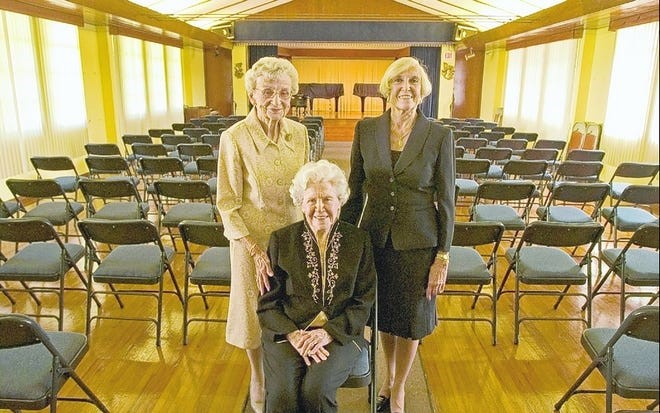
(above) Margaret Quillin, Thelma Kells, and Mary Alice Moran, at the newly renovated Tuesday Music Club in 2007.
Yearbook, 2011-2012: Monthly musical offerings are only briefly noted now with no specifics on what is being performed. It does not appear that any of the programs feature members of the Club as primary performers. There is no longer a list of monthly hymns. Instead, there is “Together We Sing, Second Edition, Monthly Songs for Music Clubs” published by the National Federation.
Yearbook 2012-2013: The Ways and Means Committee continued to conduct fundraisers for general funds and scholarships and projects to enhance the community. For May 5-12 they note: “Each year we join with music clubs across the country to celebrate a week of music making. This year the TMC will offer an entire week of music making including performances at area assisted living facilities, providing piano music at Lakeland Regional Medical center, and presenting programs for children at Lighthouse Ministries and the Salvation Army.” The Club continued to have Music Study books that were discussed at some meetings. This year the scholarship winners performed on both the April and May meetings. The Club awarded five scholarships.
Yearbook, 2013-2014: The Polk State Vocal Jazz Ensemble joined the usual groups that performed for the Club. Continuing as it had for several years, the catered lunch menus (“subject to change”) are listed for each month.
Yearbook, 2015-2016: The cover announces “95 Years Young !!!” David Stockton was the Bay Ridge District President and the Treasurer of the Club. The All Saints Academy Orchestra performed in April along with the College Level scholarship winners. In November Paula Parshé (chair of the Florida Southern Music Department) “presents Parade of American Music Celebration of Women Composers.”
Yearbook, 2016-2017: The cover says “96 years young!!!” More pictures are included. The Club has moved to the United Women’s Club of Lakeland Clubhouse where it rents the facility for its meetings. The new address is 1515 Williamsburg Square in Lakeland. The Club sold the Tuesday Music Club building, which had served as its ”beloved, weary and aged clubhouse on Park Street” for over sixty years. The January 10th meeting featured a “TMC Member Showcase” that included “a variety of comedic, musical, and thespian presentations.” There are eight scholarship winners. An index page is added to the back of the Yearbook.
Yearbook, 2017-2018: Starting this year, the Tuesday Music Club became the Lakeland Music Club and introduced a new logo incorporating a swan, reflecting Lakeland as the Swan City. The Club began a Pre-Meeting Fellowship time a half hour before the meeting, taking the place of the catered luncheon. Special presentations included Dr. Daryl Ward, principle of Harrison School for the Arts; Dr. Charles Hulin, Chair of the Music Department at Southeastern College, Brian Blume, instructor of percussion at Southeastern, and Mark Thielen, Conductor of the Imperial Symphony Orchestra.
Yearbook, 2018-2019: The year’s programs included a Suzuki Strings Concert, the Rochelle School of the Arts Choral Concert, and the Dampier String Ensemble. Websites of Interest are noted.
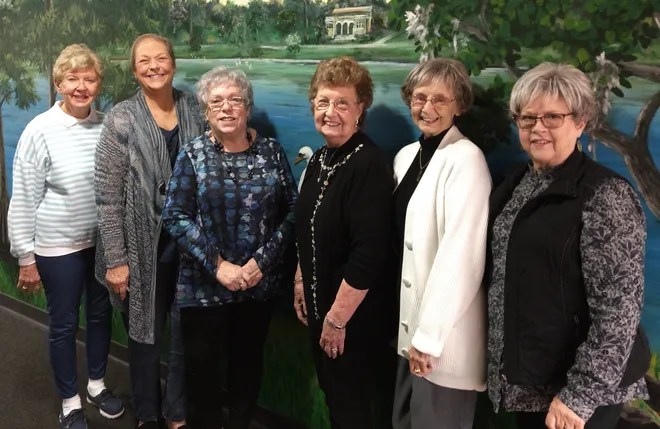
(above) The 2019-2020 Lakeland Music Club officers: Beverly Springer, corresponding secretary; Judy McLaurin, first vice president; Sheila Arthur, president; Kathy Harrison, second vice president; Jean Harkins, treasurer; and Elaine Rosson, recording secretary.
Yearbook, 2019-2020: The Yearbook had a new format and was now spiral bound instead of stapled. The Lakeland Christian School Vocal & Instrumental Fine Arts Department presented a concert in January. Scholarships were now set at $1,500 first place, $1000 second place, and $750 third place in both high school and college divisions.
Yearbook, 2020-2021: No Yearbook or meetings due to the Covid-19 pandemic.
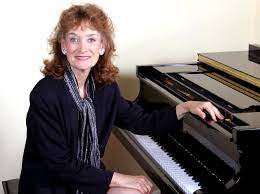
(above) Rebecca Renfore Borneman, a performer in the Centennial Celebration program.
Yearbook, 2021-2022: The cover includes “100 Years Young,” announcing the Club’s 100th year in existence. There are 42 Active Members. The Yearbook notes “There may be adjustments/Changes to Programs if Covid-19 Restrictions Change.” The first program of the year featured Club members because outside performers could not be secured that early in the season due to the pandemic. A ”Centennial Celebration” on December 14 featured Rebecca Renfore Borneman, former LMC Scholarship Winner; Dolly Roberts, Imperial Orchestra Harpist; Harrison School of the Arts Students; and Special Guest Bill Muntz, the Mayor of Lakeland.
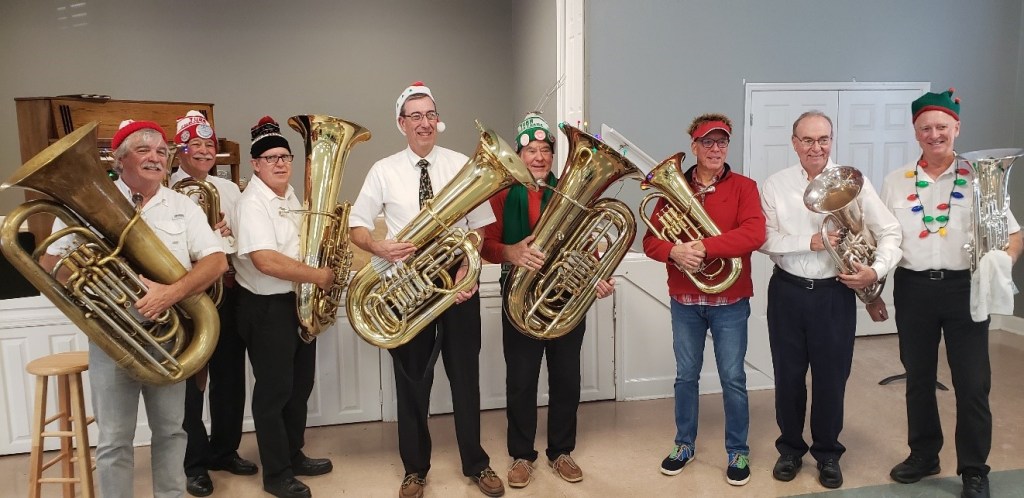
(above) A “Tuba and Euphonium Christmas” presented by members of the Bartow Adult Concert Band in 2022.
Yearbook, 2022-2023: This year the Yearbook includes the music and text for each Song of the Month. The October meeting was a “Welcome Back Membership Appreciation Day, A Morning of sing-alongs, games, prizes, and a history of musical instruments.” Other programs included a “Tuba and Euphonium Christmas” with members of the Bartow Adult Concert Band, “Musical Theater Sisters” featuring Rebecca Renfroe Borneman, Renee Hauk, and Amanda LeVasseur, and Ken Brady singing “Beautiful Irish Songs.” Brady was a lead singer with the Casinos, a doo-wop group whose recording “Then You Can Tell Me Goodbye” hit No. 6 on the Billboard Hot 100 chart in 1967
 Lakeland Music Club, est. 1921